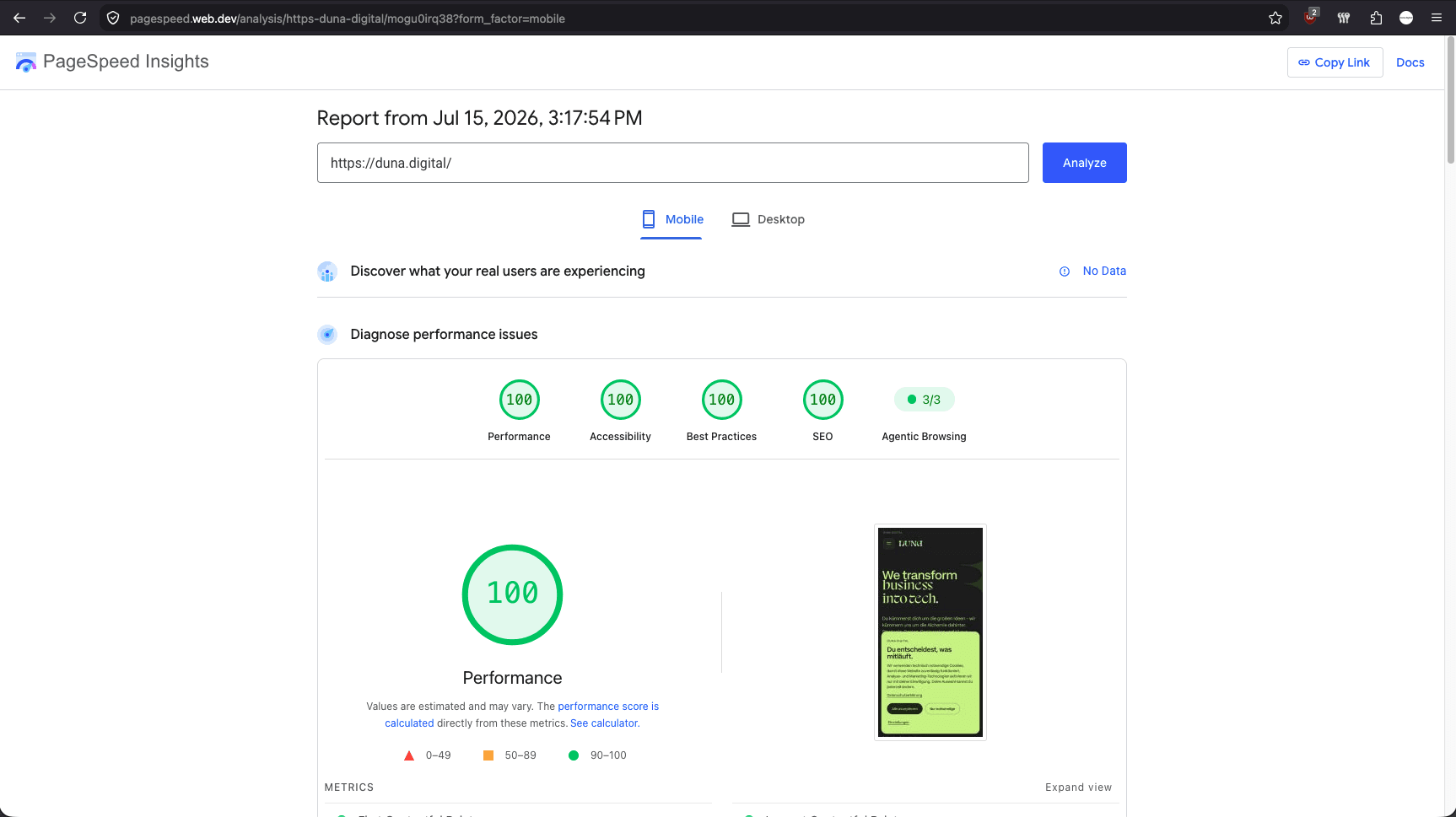
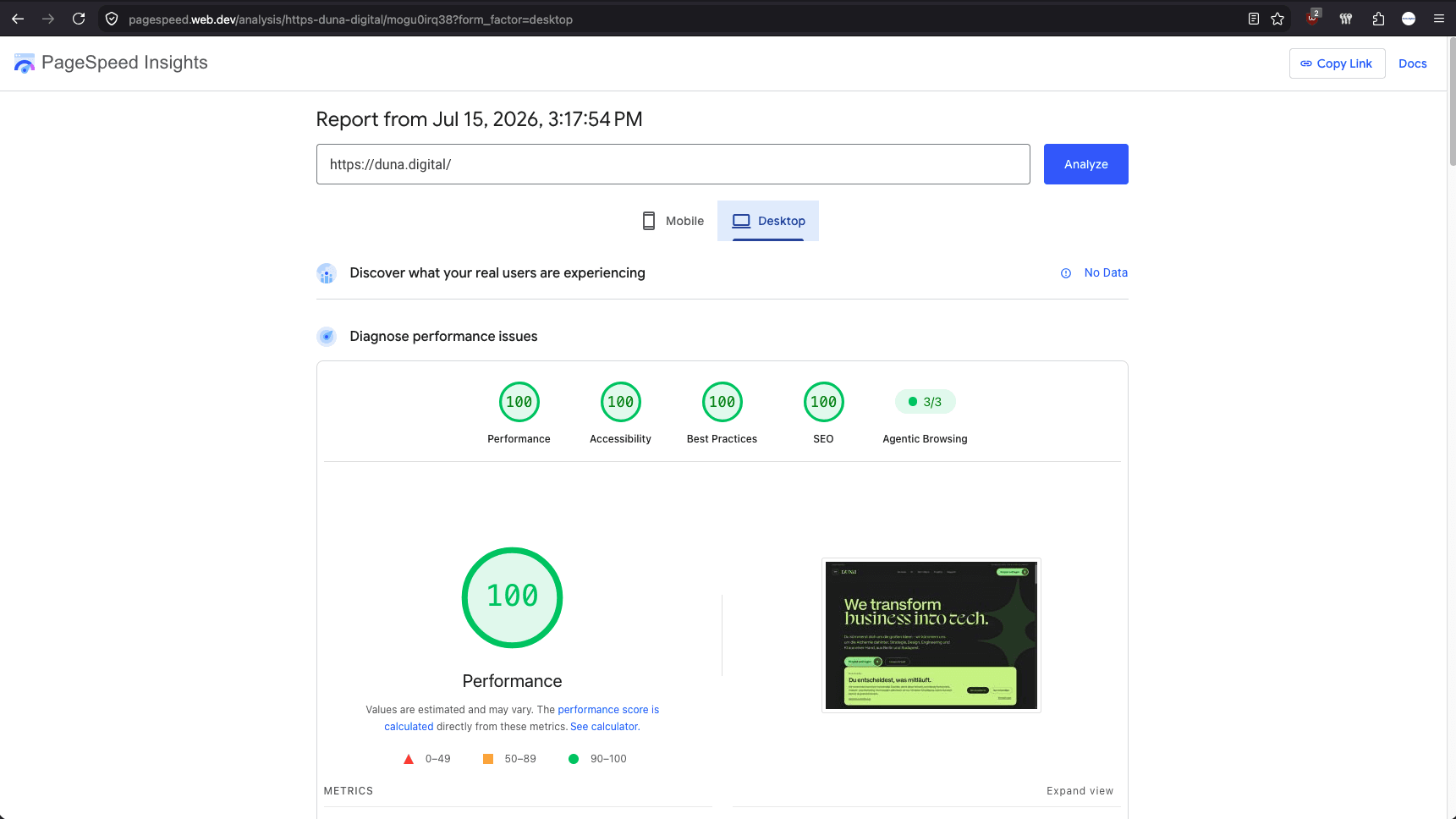
- PageSpeed Insights scored duna.digital at 100 for performance, accessibility, best practices and SEO on both mobile and desktop on 15 July 2026.
- The result did not come from one trick. It came from a lean delivery architecture, very little browser JavaScript, a controlled image and font pipeline, and a clean consent model.
- The four 100s are a reproducible lab result, not a promise for every visit. Real Core Web Vitals must also be monitored with field data.
Transparency: the screenshots document a real PageSpeed Insights run. At the time of measurement, the rebuilt site did not yet have sufficient CrUX field data. Lighthouse tests a simulated lab environment. That distinction matters and is not fine print.
It would be a little awkward to sell fast, polished and technically sound websites while making visitors wait on our own. We are maximalists on client work, so duna.digital had to become our strictest client. Not as an empty performance demo, but as a real bilingual website with a magazine, case studies, animation, consent and a contact form.
The stress test: four perfect scores on mobile and desktop
You feel a fast website before you see a number: navigation responds immediately, content stays where it belongs, and changing pages never feels like waiting. That was the goal of the complete duna.digital rebuild. PageSpeed Insights then made the outcome measurable.
Why we did not simply install a performance plugin
PageSpeed optimization does not begin at the end of a project. Trying to rescue a heavy frontend after launch with cache plugins and minification switches treats symptoms. We rebuilt the website as a system and treated performance as a product requirement from architecture through release.
Public pages are generated in advance as complete HTML and delivered with as few runtime dependencies as possible. Editorial content, media and forms are connected so a normal page view does not wait for heavy application logic. The result is fast, resilient delivery.
The seven engineering levers behind the Lighthouse score of 100
1. HTML first, JavaScript only for real interaction
Articles, service pages, case studies, navigation and metadata arrive as complete HTML. We load browser JavaScript only for functions that genuinely need client-side state. Everything else needs no hydration. Less JavaScript means less download, less parsing and less work on slower phones.
2. Route-specific CSS instead of one global grab bag
The global stylesheet contains only what every page needs. Article, case-study and teaser styles load only on routes that actually use those blocks. Tailwind CSS 4 helps maintain a consistent design system, but the decisive factor is the discipline not to ship unused component styles on every route.
3. Fonts as a controlled budget
PP Mori and Glazier define the brand. Critical faces are delivered as reviewed WOFF2 subsets containing the complete German and English character inventory used by the website. Only truly above-the-fold fonts are preloaded. The visual identity stays intact without blocking the first render with unnecessary font files.
4. Responsive AVIF and WebP from a deterministic pipeline
Every CMS image receives AVIF and WebP derivatives at several widths during the build. The frontend uses srcset and sizes to send the right file for the display. Intrinsic dimensions prevent layout shifts. Only above-the-fold media are prioritized, while everything else remains lazy.
5. Third-party scripts do not run by default
The first-party consent manager sets the consent state before optional scripts. Analytics and marketing services remain inactive until approval, while form protection loads only when needed. This protects data and avoids unnecessary JavaScript.
6. Caching, compression and immutable assets
Versioned files can remain cached in browsers and at the Cloudflare edge for a long time. HTML stays deliberately updateable, and compressible content is transferred compressed. The goal is not the longest possible cache lifetime everywhere. It is the right split: a new URL for new content and a long lifetime for immutable assets.
7. The build proves its own completeness
Before release, automated checks cover content, links, media, metadata, language variants and structured data. Only fully verified builds are published; recovery and rollback are part of the release design from the outset.
What a Lighthouse score of 100 means and what it does not
Lighthouse generates lab data under defined conditions. The result can vary with test location, network routing, browser version and other circumstances. Google itself recommends thinking about performance as a distribution rather than one magical number.
Real user experience also depends on Core Web Vitals field data: Largest Contentful Paint for loading, Interaction to Next Paint for responsiveness and Cumulative Layout Shift for visual stability. PageSpeed Insights obtains these data from the Chrome User Experience Report once there are enough real visits. Our next measurement is therefore not the hundredth screenshot, but the trend across the coming 28-day windows.
A 100-point run is strong technical evidence. It does not replace continuous monitoring, sound information architecture, useful content, conversion optimization or user research.
Does this only work with Astro?
No. Astro is an excellent fit for this website because almost everything is static content. The same principles apply to WordPress, Laravel and custom PHP applications: render on the server or statically, control the JavaScript budget, deliver media correctly, measure database and cache paths, govern third parties and make releases reproducible.
A well-engineered WordPress site can be extremely fast. A Laravel platform can deliver excellent Core Web Vitals despite complex business logic. Conversely, the newest framework cannot rescue uncontrolled scripts, oversized images or weak hosting and release processes. We choose the stack for the job, not for fashion.
What if the website operates in a BaFin-regulated environment?
Speed alone does not make a website BaFin-compliant, and there is no official BaFin seal for websites. Regulated projects add further requirements: traceable changes, access controls, controlled releases, credible operations and recovery processes, and documented third-party governance.
Our performance pipeline supports those requirements because builds are reproducible, artifacts are verifiable and releases require deliberate approval. It is still only one building block. Our article on web development in the BaFin environment explains what regulated clients demand in practice based on our Finoa and König Leasing projects.
Can you commission a website with a score of 100?
You can commission a website built around a clear performance budget, measurable targets and reliable operations. An agency should still not guarantee an identical Lighthouse score forever because the test system and external conditions change. What can be guaranteed is the process, the architectural decisions, the test regime and the response to regressions.
For a relaunch, we begin with audiences, content and conversion paths. We then define performance budgets for JavaScript, CSS, fonts and images. Before release, we test real pages and viewports rather than an empty demo. After launch, Search Console, Core Web Vitals and, where appropriate, our own Real User Monitoring complete the loop.
Frequently asked questions
Can a Lighthouse score of 100 be guaranteed?
Not permanently for every run. Test conditions and Lighthouse versions change. A site can, however, be built and continuously tested to remain comfortably in the green and reach 100 under reproducible lab conditions.
Is PageSpeed 100 the same as passing Core Web Vitals?
No. A Lighthouse score is a lab result. Core Web Vitals assess real user experiences with field data, normally over a rolling 28-day window. Both perspectives belong together.
Can a WordPress website score 100?
Yes, depending on its content and features. Theme and plugin quality, rendering, image delivery, caching, hosting and third parties matter. WordPress itself is not a disqualifier.
Does a score of 100 make a website BaFin-compliant?
No. Performance is one quality signal. Regulated environments additionally require technical, organizational and contractual controls.
- Google: About PageSpeed Insights - the distinction between lab and field data
- Chrome for Developers: Lighthouse performance scoring - score calculation and variability
- web.dev: Web Vitals - LCP, INP, CLS and field data